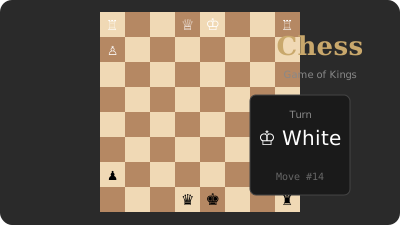
Chess
The ultimate strategy game. Play against AI or practice tactics. White moves fir...
Chess
📖 How to Play
White moves first. Each piece moves differently. Goal: Checkmate the opponent's king!
📚 Complete Game Guide
Chess - Complete Game Guide
🎮 Game Overview
Chess is the ultimate strategy game—a 1500-year-old battlefield of minds where two players command armies of 16 pieces each, battling for control of a 64-square board. With over 600 million regular players worldwide, chess is the most popular board game in history. It's not just a game; it's art, science, sport, and philosophy combined. Every game is a unique story of deception, sacrifice, brilliance, and blunder.
📜 History & Cultural Impact
- 6th Century: Origins in northern India (Chaturanga)
- 9th Century: Spreads to Persia; name "chess" derives from "shah" (king)
- 15th Century: Modern rules established in Europe (queen becomes most powerful piece)
- 1851: First international chess tournament held in London
- 1886: First official World Chess Champion: Wilhelm Steinitz
- 1997: IBM's Deep Blue defeats World Champion Garry Kasparov
- 2023: Over 600 million regular players worldwide; chess boom during COVID-19
🎯 How to Play
Basic Rules
- The Board: 8x8 grid with alternating light and dark squares
- The Armies: Each player controls 16 pieces (1 king, 1 queen, 2 rooks, 2 bishops, 2 knights, 8 pawns)
- The Goal: Checkmate the opponent's king (king is under attack and cannot escape)
- Turns: White moves first; players alternate moving one piece per turn
- Game End: Checkmate (win), resignation, draw (stalemate, insufficient material, or agreement)
Piece Movements
King
- Moves one square in any direction
- Cannot move into check
- Special: Castling (move king two squares toward rook, rook jumps over)
Queen
- Most powerful piece
- Moves any number of squares in any direction (horizontal, vertical, diagonal)
Rook (Castle)
- Moves any number of squares horizontally or vertically
- Special: Participates in castling
Bishop
- Moves any number of squares diagonally
- Each bishop stays on its own color squares
Knight
- Moves in L-shape (2 squares in one direction, 1 square perpendicular)
- ONLY piece that can jump over other pieces
Pawn
- Moves forward one square (two on first move)
- Captures diagonally (one square forward-diagonal)
- Special: En passant capture
- Promotion: Reaches eighth rank, becomes queen/rook/bishop/knight
Special Moves
- Castling: King moves two squares toward rook; rook jumps over king (conditions apply)
- En Passant: Pawn captures opponent's pawn that just moved two squares (only immediately after)
- Promotion: Pawn reaching eighth rank becomes any piece (usually queen)
🧠 Strategy Guide
Opening Principles (Beginners)
- Control the Center: Occupy d4, d5, e4, e5 with pawns or pieces
- Develop Pieces: Bring knights and bishops out early
- King Safety: Castle early (usually within first 10 moves)
- Don't Move the Same Piece Twice: In the opening, develop, don't redeploy
- Don't Bring the Queen Out Early: She becomes a target
Common Opening Systems
- 1. e4 e5 (Open Games): Tactical, sharp play
- 1. e4 c5 (Sicilian Defense): Most popular response to 1.e4
- 1. d4 d5 (Queen's Pawn Game): Solid, strategic play
- 1. d4 Nf6 (Indian Defenses): Hypermodern, dynamic
- 1. c4 (English Opening): Flexible, flank control
Middlegame Strategy
- Pawn Structure: Understand isolated pawns, doubled pawns, passed pawns
- Piece Activity: Active pieces > material advantage
- King Safety: Keep your king safe; attack opponent's king
- Prophylaxis: Prevent opponent's plans before they execute them
Endgame Essentials
- King Activation: In endgames, the king becomes a fighting piece
- Pawn Promotion: Create passed pawns and escort them to promotion
- Opposition: King vs king technique (critical in king+pawn vs king endgames)
- Basic Checkmates: King+queen vs king; King+rook vs king (learn these!)
Tactical Patterns (Must Know!)
- Fork: One piece attacks two or more enemy pieces simultaneously
- Pin: Piece cannot move because it would expose a more valuable piece (usually king) to capture
- Skewer: Like a pin, but the more valuable piece is in front
- Discovered Attack: Moving a piece reveals an attack from another piece
- Double Check: Two pieces check the king simultaneously (king MUST move)
- Zugzwang: Player would prefer to pass, but must move (disadvantageous position)
Common Mistakes
- Moving too fast without calculating
- Ignoring opponent's threats
- Bringing queen out too early
- Not castling (king stuck in center)
- Playing hope chess ("I hope my opponent doesn't see this...")
- Not studying endgames
🏆 World Champions & Legends
- Garry Kasparov: Longest reigning champion (1985-2000); aggressive, brilliant
- Magnus Carlsen: Current World Champion (2013-2023); highest rating ever (2882)
- Bobby Fischer: American legend; defeated Boris Spassky in 1972 "Match of the Century"
- Judit Polgar: Strongest female player in history; defeated 11 world champions
- Hikaru Nakamura: Top blitz/speed chess player; popular streamer
📊 Chess Formats
- Classical: 90+ minutes per player (deep thinking)
- Rapid: 10-25 minutes per player
- Blitz: 3-5 minutes per player
- Bullet: 1 minute per player (extreme speed)
- Puzzle Rush: Solve as many tactics as possible in limited time
- Bughouse: Teammate-based variant (capture pieces given to teammate)
- Chess960 (Fischer Random): Random starting position (memorization irrelevant)
💡 Benefits of Playing Chess
- Improves IQ: Studies show chess players have higher intelligence scores
- Enhances Problem-Solving: Strategic thinking transfers to real life
- Teaches Planning: You must think ahead (calculate variations)
- Develops Patience: Rushed moves = blunders
- Builds Character: You learn to accept defeat and learn from mistakes
🏆 World Records & Achievements
- Highest Rating Ever: Magnus Carlsen (2882, 2014)
- Youngest Grandmaster: Abhimanyu Mishra (12 years, 4 months, 2021)
- Longest Game: 269 moves (Ivan Nikolic vs. Goran Arsovic, 1989; drew after 20 hours)
- Fastest Checkmate: Fool's Mate (2 moves: 1.f3 e5 2.g4 Qh4#)
💡 Fun Facts
- The number of possible chess games exceeds the number of atoms in the observable universe
- The second move (1...e5) is the most common response to 1.e4
- Computers (Stockfish, AlphaZero) now surpass even the strongest humans
- Chess is a recognized sport by the International Olympic Committee
- There are more chess books published than books about all other games combined
Ready to command your army? Start Playing Chess Now
🎮 Controls
Share This Game
🎮 Related Games

Mindustry Classic
The classic build of Mindustry — an open-source factory-building tower-defense game. Mine resources, build conveyor belts, craft ammo, and defend your core from endless waves of enemies. Pure browser version based on build 40.
2048
The legendary number puzzle! Merge tiles to reach 2048. Simple to learn, impossible to put down.
Minesweeper
Classic logic puzzle! Clear the minefield without detonating a mine. Numbers show adjacent mines.
Snake
The classic mobile game! Eat food, grow longer, don't hit yourself or the walls.
💬 Comments
Coming soon! Sign in to leave a comment.