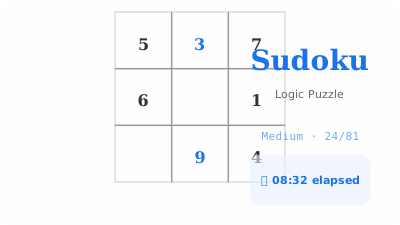
Sudoku
The addictive number placement puzzle. Fill the grid with 1-9, no repeats in row...
Sudoku
📖 How to Play
Fill each row, column, and 3x3 box with digits 1-9. No repeats allowed!
📚 Complete Game Guide
Sudoku - Complete Game Guide
🎮 Game Overview
Sudoku is the world's most popular logic-based number placement puzzle. Originating in Switzerland in 1783 as "Latin Squares" by mathematician Leonhard Euler, it was later popularized in its modern form by Japanese puzzle company Nikoli in 1986. The name "Sudoku" comes from Japanese "su" (number) and "doku" (single), meaning "the numbers must be single." With over 100 million players worldwide, Sudoku is the ultimate brain teaser that requires no math—only pure logical reasoning.
📜 History & Cultural Impact
- 1783: Leonhard Euler invents "Latin Squares" in Switzerland
- 1979: Howard Garns creates "Number Place" (modern Sudoku precursor) in the US
- 1986: Nikoli company in Japan popularizes it as "Sudoku"
- 2004: The Times of London begins publishing daily Sudoku puzzles
- 2005: Sudoku craze sweeps the globe; becomes a daily feature in newspapers worldwide
- Today: Over 100 million regular players;apps, books, and championships worldwide
🎯 How to Play
Basic Rules
- The Grid: 9x9 grid divided into nine 3x3 subgrids (boxes)
- The Goal: Fill the grid so every row, column, and 3x3 box contains digits 1-9 exactly once
- Starting Point: The puzzle begins with some numbers already filled in (clues)
- No Guessing: Every proper Sudoku has exactly one unique solution—pure logic required!
Controls
- Keyboard: Type numbers 1-9 to fill cells; 0 or Delete to erase
- Mouse/Touch: Click/tap a cell, then click/tap a number to fill it
- Notes Mode: Toggle to mark possible numbers in a cell (pencil marks)
Difficulty Levels
- Easy: 36+ clues (more starting numbers)
- Medium: 30-35 clues
- Hard: 25-29 clues
- Expert: 17-24 clues (minimum for unique solution is 17)
- Evil: 17 clues, carefully placed for maximum difficulty
🧠 Strategy Guide
Beginner Techniques
1. Sole Candidate (Naked Single)
- If a cell has only one possible number, fill it in
- Example: If a row already has 1,2,3,4,5,6,7,8—the empty cell must be 9
2. Unique Candidate (Hidden Single)
- If a number can only go in one cell within a row, column, or box—place it there
- Scan rows, columns, and boxes to eliminate possibilities
3. Cross-Hatching
- Focus on one number at a time
- Look at where that number already appears in rows/columns/boxes
- Eliminate those positions for that number in related units
Intermediate Techniques
4. Pencil Marks (Candidates)
- Mark all possible numbers for each empty cell
- As you eliminate possibilities, update pencil marks
- Look for "naked singles" (only one candidate left in a cell)
5. Pointing Pairs/Triples
- If a number can only appear in two or three cells within a box—and those cells share a row or column—eliminate that number from other cells in that row/column
6. Box/Line Reduction
- If a number can only appear in one row or column within a box—eliminate that number from that row/column in other boxes
Advanced Techniques
7. Naked Pairs/Triples/Quads
- If two cells in a unit (row/column/box) have exactly the same two candidates—eliminate those candidates from other cells in that unit
- Extends to triples (3 cells, 3 candidates) and quads (4 cells, 4 candidates)
8. Hidden Pairs/Triples/Quads
- If two numbers appear as candidates in exactly two cells within a unit—those two cells must contain those two numbers (eliminate other candidates from those cells)
9. X-Wing
- Advanced technique for eliminating candidates using rectangle patterns
- Involves two rows (or columns) where a candidate appears in exactly two cells in each row—forming a rectangle
Common Mistakes
- Guessing instead of using logic
- Not using pencil marks early enough
- Focusing on one cell too long instead of scanning the whole grid
- Missing obvious "sole candidates"
- Not double-checking before placing a number
📊 Benefits of Playing Sudoku
- Improves Concentration: Requires sustained focus
- Enhances Logical Thinking: Pure reasoning, no math required
- Boosts Memory: Remembering possibilities and eliminations
- Reduces Stress: Meditative, flow-state inducing
- Slows Cognitive Decline: Studies show regular puzzle play helps maintain brain health
🏆 World Championships
- World Sudoku Championship: Annual competition since 2006
- Records: Fastest solve of expert puzzle: under 2 minutes
- Notable: Some players solve blindfolded or with pen only (no erasures allowed)
💡 Fun Facts
- A proper Sudoku puzzle has exactly one unique solution
- The minimum number of clues for a unique solution is 17
- There are 6,670,903,752,021,072,936,960 possible Sudoku grids
- Sudoku is not of Japanese origin despite the name—it's Swiss/American/Japanese combined
- Some newspapers offer "Killer Sudoku" (adds arithmetic element)
Ready to challenge your brain? Start Playing Sudoku Now
🎮 Controls
Share This Game
🎮 Related Games
2048
The legendary number puzzle! Merge tiles to reach 2048. Simple to learn, impossible to put down.
Minesweeper
Classic logic puzzle! Clear the minefield without detonating a mine. Numbers show adjacent mines.
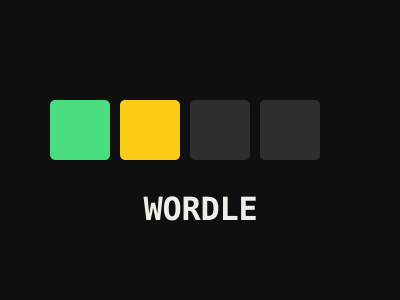
Wordle
The viral daily word puzzle! Guess the 5-letter word in 6 tries. Green = correct, Yellow = wrong position, Gray = not in word.

Time Shooter 3
A unique FPS where time moves only when you move! Clear enemy waves strategically.
💬 Comments
Coming soon! Sign in to leave a comment.